




The DSA Elevation System in a Nutshell
New to competitive DanceSport? You've probably heard people chatting about "Grades," "Points," and "Elevation", and wondered what it's all about. Don't worry – once you understand the basics, it all makes sense.
This guide breaks down the DSA Elevation System in plain English so competitors and parents can get their heads around how it all works.
Why Do We Have an Elevation System?
Picture this: you've just started learning to dance and you enter your first comp. Would it be fair to go up against couples who've been dancing for years? Not really – and it wouldn't be much fun either!
That's the whole point of the Elevation System. It groups competitors by skill level so you're dancing against people at a similar stage in their journey. Beginners compete with beginners, and experienced dancers challenge each other at a higher level.
The system also gives you clear goals to work towards. As you improve and place well at competitions, you earn points that eventually "elevate" you to the next Grade – a bit like levelling up in a video game!
Understanding the Grades
Both the Under 16 Division and Amateur Division use the same grading structure:
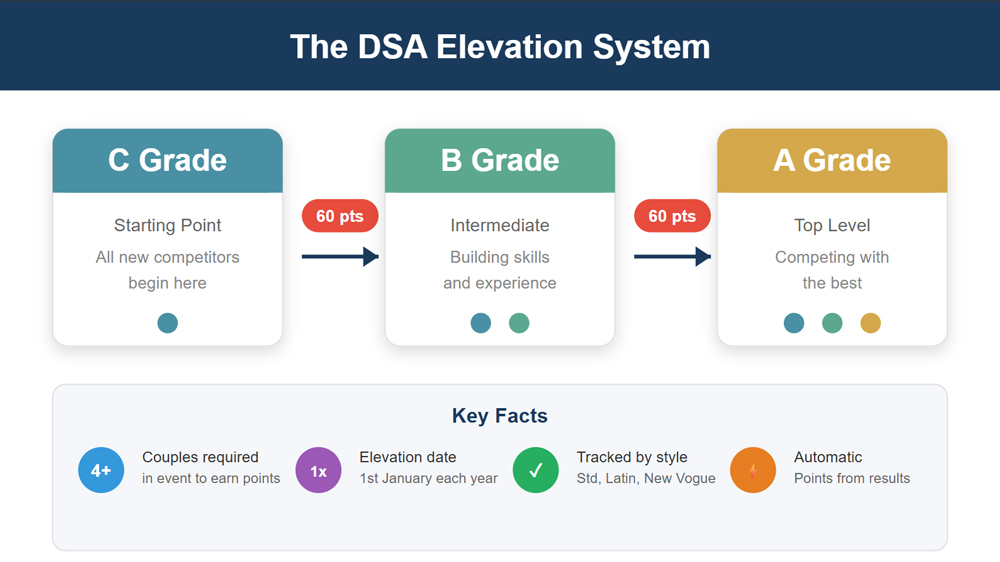
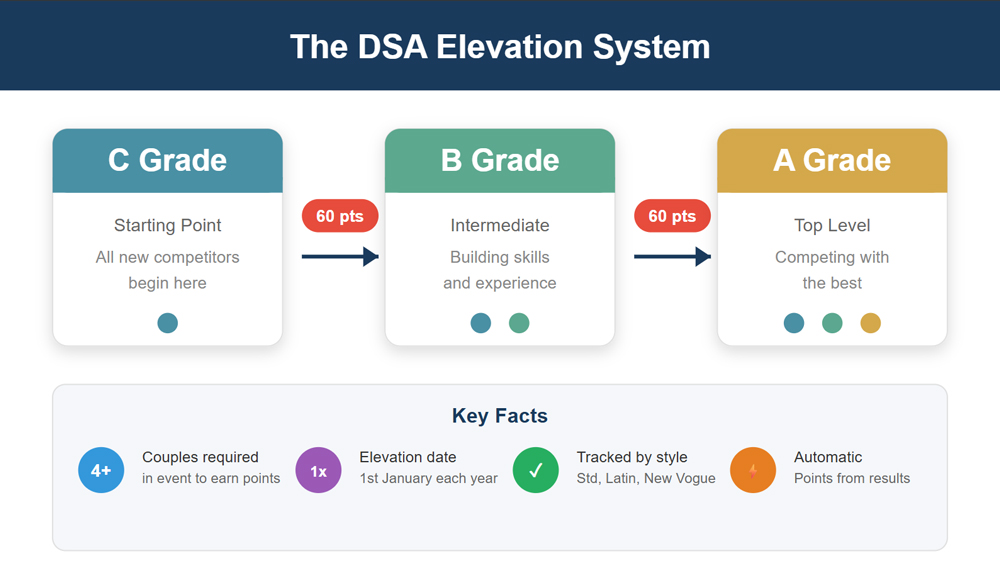
C Grade → B Grade → A Grade
Everyone starts at C Grade. As you compete and do well, you'll earn Elevation Points that move you up the ladder to B Grade, and eventually to A Grade.
How Do You Earn Elevation Points?
You earn Elevation Points by winning (1st Place) in Graded events at competitions. It's that simple!
All levels of competition carry Elevation Points for Graded events (Couple, Solo or Lead/Follow), except Development Competitions.
- Australian Championship = 60 Points
- National Championship = 30 Points
- State Open & Championship = 20 Points
- Competition = 10 Points
Development competitions do not award Elevation Points.
NOTE: The Australian Championship is an exception; all Under 16 Division and Amateur Division wins carry 60 Elevation Points, even the 'Open' events!
There's one important rule to know: you need actual competition to earn points. Your event must have at least 4 couples (or solo competitors) for you to receive Elevation Points. So if you're the only one on the floor, you won't get Elevation Points for that event – you need to beat at least 3 others to earn your points.
The best part? You don't have to do any paperwork! After each competition, the results are uploaded directly from the scrutineering system straight to your online DSA account. Just log in, and you can see exactly how many Elevation Points you've earned.
How Many Points Do You Need to Elevate?
The magic number is 60 Elevation Points.
Once you've accumulated 60 Elevation Points in a style, you're ready to move up to the next Grade at the next elevation date, in that style.
When Does Elevation Happen?
Elevation doesn't happen the instant you hit 60 points. Instead, points are reviewed and elevations processed at the start of each year on the 1st January.
So even if you've reached 60 points mid-season, you'll keep competing in your current Grade until the next elevation date. This keeps things stable and predictable for everyone – competitors, coaches, and competition organisers alike.
Can't wait? You can request early elevation (called "self-elevation") at any time by contacting the Admin Team.
What Happens to Your Points When You Elevate?
When you elevate, your points reset to zero. You're starting fresh in your new Grade! Those extra points don't carry over – if you had 80 points and you only need 60, the extra 20 disappear.
But here's the flip side: if you don't have enough points at the elevation date, you keep what you've got. Your points roll over into the next assessment period, so you're not starting from scratch.
Special Rules for Young Dancers
There's an important rule for Sub-Juvenile, Juvenile and Junior competitors in the Under 16 Division: when you move to the next Age Group, your Grade drops back by one level.
For example, if you're a Junior A Grade competitor and you turn 16, you'll become an Under 21 B Grade competitor – not A Grade. This recognises that you're now competing against older, more experienced dancers.
Points Are Tracked by Style
Your Elevation Points are tracked separately for each style – Standard, Latin, and New Vogue all have their own point tallies. This means you might be B Grade in Latin but still C Grade in Standard. Each style progresses independently based on your results in that style.
Quick FAQs
Do A Grade and Professional competitors earn points?
No. Once you hit A Grade, that's the top of the graded ladder. A Grade and Professional competitors don't elevate further.
Do Open events earn points?
Generally, no – only Graded events attract Elevation Points. The exception is the Australian Championship, where both Open and Graded events count.
What about winning at the Australian Championship?
A win at the Aussie Champs (with 4 or more couples in the event) results in automatic elevation on the next elevation date. That's a nice reward for the Australian Championship title!
Can I check my points online?
Absolutely. Log into your DSA account to see all your competition results and accumulated Elevation Points in each style.
What if I want to move up before I have 60 points?
You can request self-elevation at any time through the Admin Team. Some competitors choose to move up early to challenge themselves against stronger competition.
The Bottom Line
The Elevation System is designed to make competition fair and fun for everyone. Dance well, earn your 60 points, and you'll move up to dance with others at your new level. It's a simple system that rewards your progress and keeps you motivated to improve.
Want more details?
This blog gives you the overview, but we've got comprehensive information on every aspect of the Elevation System:
Points Introduction – How the system works
Events & Point Values – What you earn for each placing
Elevation Dates – When elevation occurs
Elevation FAQ – Common questions answered
Got more questions? The Admin Team is always happy to help!